Buying a weighing scale used to be simple. You walked into a store, picked a digital scale, and that was it.
But today, when you search online, you see two main options:
- Digital Scale
- Smart Scale
And suddenly the decision feels confusing. Are smart scales really better? Or are they just expensive versions of regular scales?
Let’s break this down in the simplest way possible.
First, Understand the Core Difference
A digital scale tells you how much you weigh. A smart scale tells you what your weight is made of.
That one difference changes everything.
Because your body is not just a number. It is made up of fat, muscle, water, protein, and bone mass. When you track only total weight, you miss the bigger picture.
When a Digital Scale Makes Sense
A digital weighing scale is suitable if:

- You only want to check weight occasionally.
- You are not following a structured fitness routine.
- You don’t need detailed health insights.
- You want a basic, low-cost solution.
Digital scales are simple. Step on, see weight, step off. No app. No tracking. No analytics. For casual use, they work fine. But they stop at weight.
Where Digital Scales Fall Short
Let’s say you start going to the gym. After a month: Your weight remains the same.
With a digital scale, you might assume: “No progress.” But that assumption could be wrong.
You might have:
- Lost fat
- Gained muscle
- Improved metabolism
A digital scale cannot show this. And that’s where many people lose motivation.
What Makes a Smart Scale Different?
A smart scale goes beyond weight. It uses bio-impedance sensor technology to measure body composition.
This includes:
- Body fat percentage
- Visceral fat
- Muscle mass
- Body water
- Protein level
- BMI
- BMR
- Metabolic age
Instead of just one number, you get a complete breakdown of your body. That means smarter decisions.
The Real Advantage: Progress Tracking Over Time
Here’s where smart scales become powerful.
They connect to an app and store your historical data.
You can track:
- Weekly fat loss
- Monthly muscle gain
- Changes in metabolic age
- Overall body trends
This long-term visibility builds consistency.
You stop reacting emotionally to daily fluctuations and start focusing on trends.
That shift improves results.
Digital Scale vs Smart Scale: Practical Comparison
If your goal is basic weight monitoring, a digital scale is enough.
If your goal is fat loss, muscle building, body transformation, or long-term health tracking, a smart scale is a smarter investment.
Digital scale = weight awareness.
Smart scale = body awareness.
In 2026, body awareness matters more.
Which One Is Better for Indian Homes?
Fitness awareness in India is growing rapidly. More people are tracking calories, steps, workouts, and sleep.
In that ecosystem, a smart scale fits naturally.

It works well for:
- Fitness beginners
- Working professionals
- Gym enthusiasts
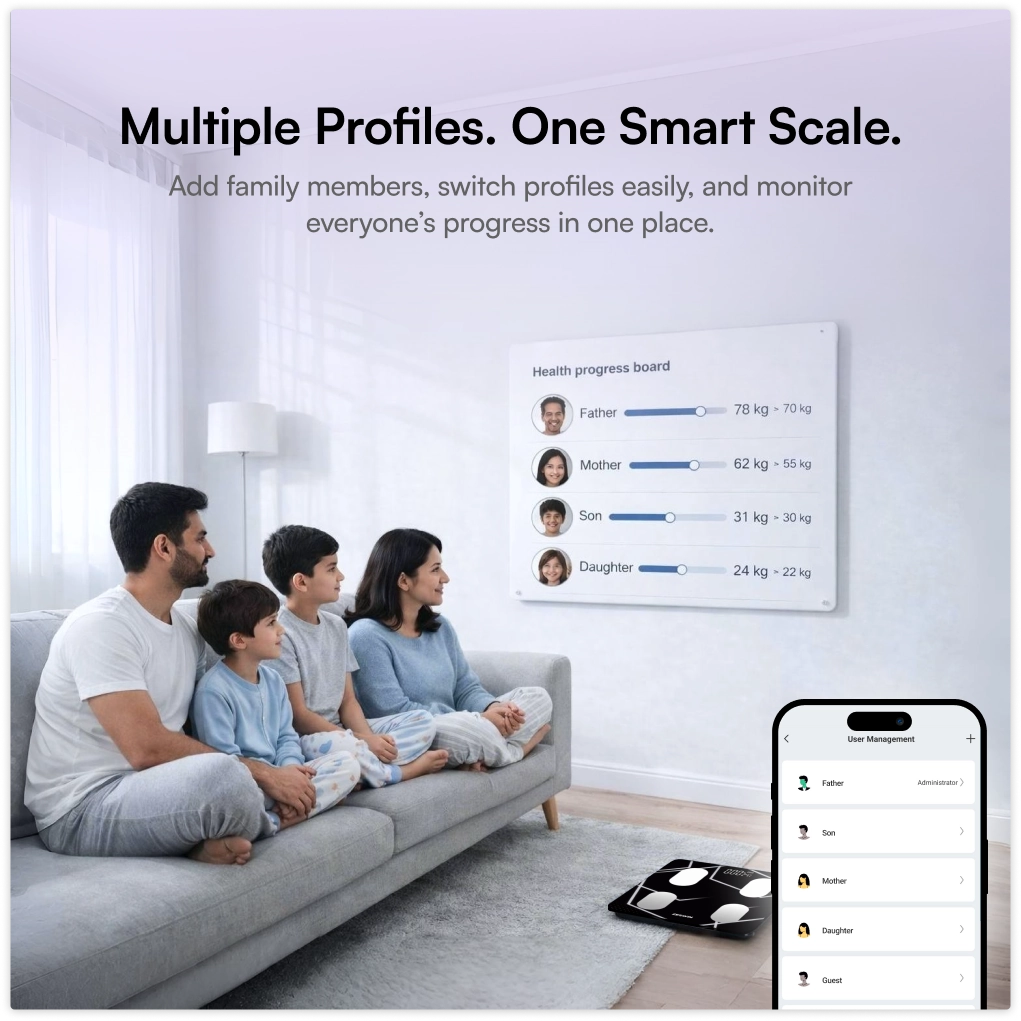
- Families tracking collective health
- People on weight loss journeys
If health tracking is becoming data-driven, your scale should match that evolution.
Is a Smart Scale Worth the Extra Cost?
This is the most common question.
The answer depends on how serious you are about fitness.
If you’re investing in:
- Gym memberships
- Protein supplements
- Diet plans
- Fitness coaching
Then not tracking body composition is like driving without a dashboard. A smart scale gives context to your efforts. Without context, numbers feel confusing. With context, progress feels clear.
A digital scale shows weight. A smart scale shows progress. If your health goals are short-term and casual, a digital scale works. If your goals are long-term and structured, a smart scale is the better choice.
In today’s fitness-focused lifestyle, clarity beats simplicity.
Choose the scale that matches your ambition.